
Best Business Intelligence Software for Enterprises in 2026: What to Look For Before You Buy
Evaluating business intelligence software in 2026? The buyer's checklist: data integration, real-time analytics, automated reporting, and hidden costs.
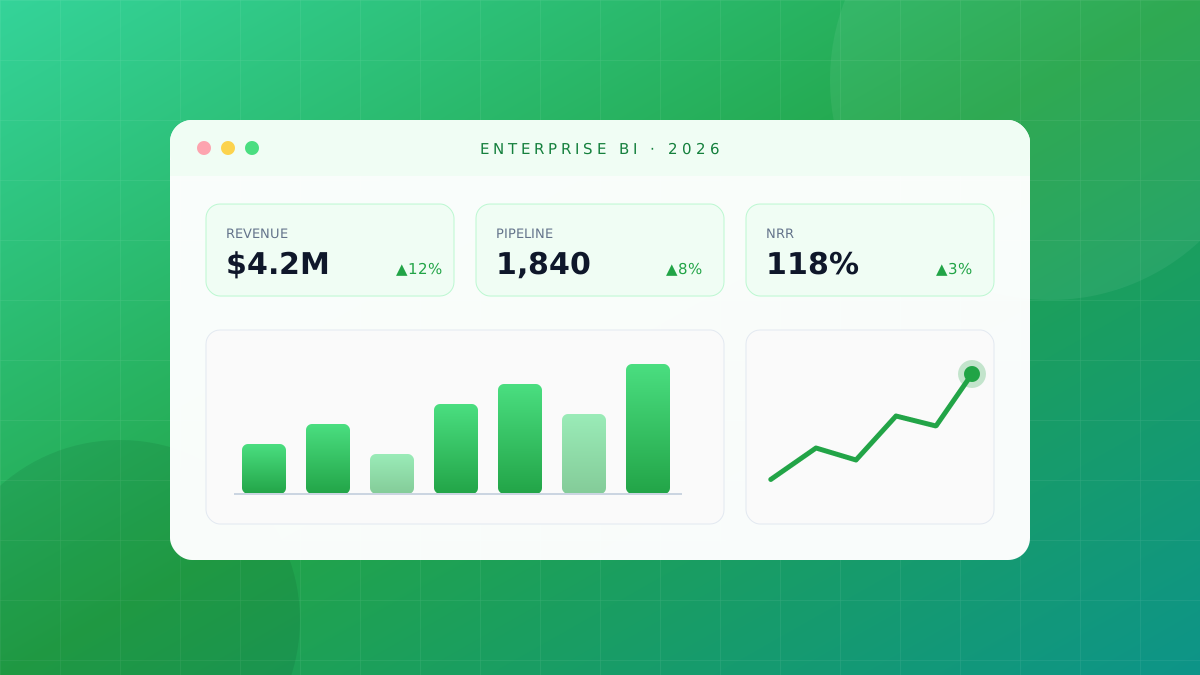
Choosing business intelligence software in 2026 means cutting through a crowded market of platforms that all promise the same thing: turn your data into decisions. Meanwhile, your organization keeps generating massive amounts of information from sales, marketing, finance, operations, and customer interactions — and without the right BI tool, that data stays fragmented across systems, where extracting one reliable insight becomes a week-long project.
A modern enterprise analytics platform consolidates data, automates reporting, visualizes performance metrics, and helps teams make faster, data-backed decisions.
This guide covers what to look for — and what to avoid — before you commit.
Why enterprises need business intelligence software
Many businesses still run on spreadsheets and manual reporting. These methods are time-consuming, error-prone, and routinely deliver insights days after the decision they were supposed to inform.
Enterprise BI software helps organizations:
- Centralize data from multiple sources
- Automate reporting and dashboard creation
- Monitor KPIs in real time
- Improve operational efficiency
- Enable data-driven decision-making across departments
The gap between companies that do this well and companies that don’t shows up directly in decision speed — and decision speed compounds.
Key features to evaluate before choosing a BI platform
1. Data integration capabilities
The platform should connect seamlessly with your CRM, ERP, databases, cloud applications, and marketing tools. Count your sources before you shop: every system the platform can’t connect to is a manual export someone owns forever.
2. Real-time analytics
Access to live business data lets teams respond to changing market conditions while they’re still changing. If the platform’s “real-time” means an overnight batch refresh, ask harder questions.
3. Interactive dashboards
Executives and department leaders need customizable dashboard software that presents complex information in a format they can act on — not a report wall nobody opens. Look for drill-downs, plain-language summaries, and mobile access. (Dashboards going unused is so common we wrote about why teams ignore dashboards — and what actually works instead.)
4. Automated reporting
Automated report delivery reduces manual effort and ensures stakeholders receive timely insights without anyone assembling slides at 11pm on a Sunday. A good automated reporting software workflow should take minutes to set up, not a services engagement.
5. Scalability
The solution should grow alongside the business and handle increasing data volumes without performance cliffs — or surprise capacity pricing tiers. Compare transparent, flat pricing against per-user-per-month models at 3× your current headcount before deciding.
See how Datalytics handles all five — connect a source and ask your first question in plain English.
What it costs to get this wrong
Organizations without the right BI solution typically struggle with:
- Siloed data across departments, each with its own version of the truth
- Manual reporting processes that consume analyst and manager hours
- Delayed insights — finding out about a problem in the monthly review instead of the day it started
- Limited KPI visibility outside the one team that owns the spreadsheet
- Inconsistent data accuracy, which quietly erodes trust in every number
These challenges compound: when reporting is slow and numbers are doubted, teams fall back to gut decisions, and the BI investment you already made stops paying for itself.
How Datalytics helps enterprises decide better
Datalytics is an AI-powered business intelligence platform designed to turn raw data into decisions without requiring a dedicated analyst team.
With Datalytics, businesses can:
- Connect multiple data sources into one unified platform
- Build interactive dashboards in minutes
- Automate reporting workflows end to end
- Monitor KPIs in real time
- Ask questions in plain English and get answers with charts — no SQL, no DAX
By eliminating manual reporting and simplifying analytics, Datalytics lets organizations focus on growth instead of pipeline maintenance.
Weighing Datalytics against a traditional tool? Read our honest Power BI vs AI-native analytics comparison. Want a concrete starting point? Steal the CFO weekly metrics pack — 12 numbers, zero analysts.
The buyer’s checklist
Before signing with any vendor, score each candidate on:
| Criterion | Question to ask |
|---|---|
| Implementation | Can a non-technical user get to first insight in a day? |
| Integration | Does it connect to our stack natively, today? |
| Reporting | Can reports be scheduled and delivered automatically? |
| Dashboards | Can department leads customize without IT tickets? |
| Security & governance | Role-based access, audit logs, data residency? |
| Scalability & support | What happens at 10× the data volume — and 10× the price? |
The right platform should meet current requirements and support where the business is going — not just where it is.
Final thoughts
Investing in the right business intelligence software pays back in operational efficiency, reporting accuracy, and decision speed. Prioritize solutions that combine real-time analytics, automated reporting, and seamless data integration — and verify each claim on your own data during the trial, not the vendor’s demo dataset.
Ready to transform your business data into actionable insights? Book a personalized Datalytics demo and see how intelligent analytics can accelerate your growth.
Frequently asked questions
What is the best business intelligence software for enterprises in 2026?
It depends on who runs it. Enterprises with dedicated analyst teams often choose Power BI or Tableau; teams without analysts get faster results from AI-native platforms like Datalytics, where anyone can ask questions in plain English and automate reporting without SQL or DAX.
How much does business intelligence software cost?
Anywhere from free plans to six-figure enterprise contracts. Watch for per-user fees, capacity tiers, and mandatory implementation services. Datalytics offers a free-forever plan and flat team pricing.
What features matter most in a BI platform?
Five essentials: native integration with your data stack, real-time analytics, interactive dashboards that department leads can customize themselves, automated report delivery, and scalability without surprise pricing tiers.
How long does it take to implement BI software?
Traditional BI deployments take weeks to months because data modeling comes first. AI-native platforms invert this: connect a source and ask your first question within minutes, then refine as you go.
We build Datalytics — the AI analytics platform that lets anyone ask their data questions in plain English. See it live →
Stop reading about analytics. Try it.
Connect a data source and ask your first question in plain English — free, no credit card.
Start free