
Why Your Team Ignores Dashboards (And What Actually Works)
Most company dashboards get opened twice: the day they ship and the day something breaks. The problem isn't your team's data culture — it's that dashboards answer questions nobody is asking anymore.
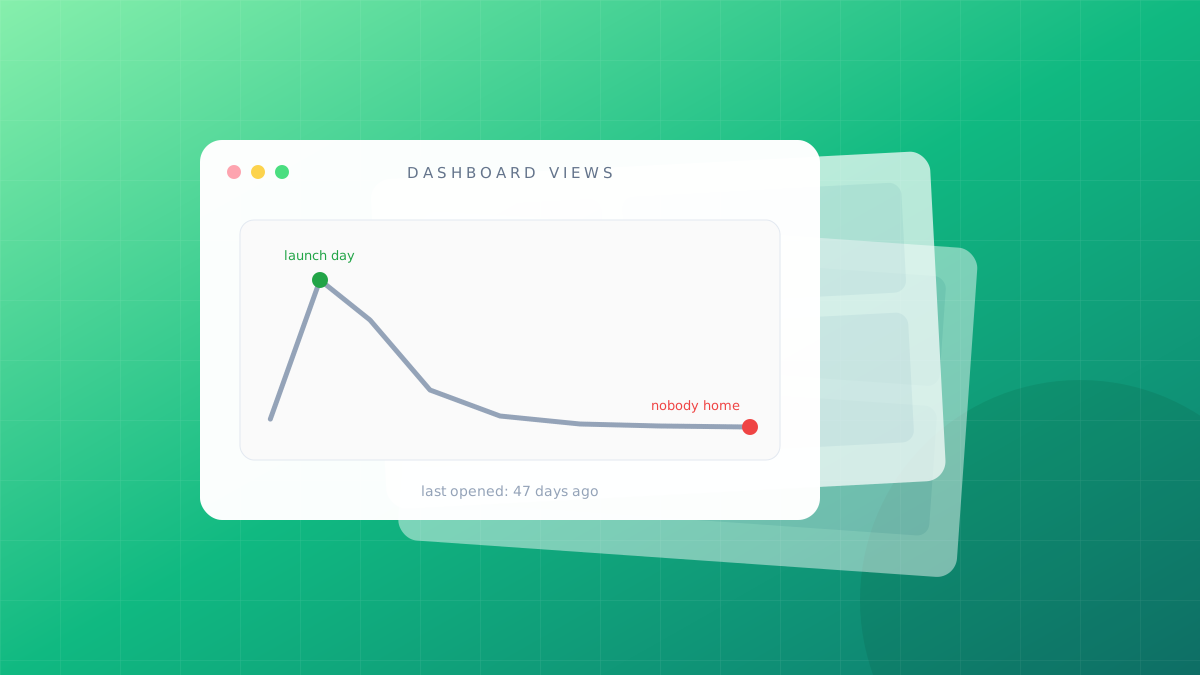
Check your BI tool’s usage stats. If you’re like most companies, the median dashboard was viewed by two people last month, and one of them built it.
This isn’t a discipline problem. Nobody needs another Slack reminder to “check the numbers.” Dashboards go ignored for structural reasons, and understanding them is the difference between a data-driven team and a team with a subscription.
Reason 1: Dashboards are answers to old questions
Every dashboard encodes the questions someone had at build time. Three months later the business moved — new pricing, new channel, new fire to fight — and the dashboard still answers March’s questions with June’s data.
The half-life of a business question is weeks. The maintenance cycle of a dashboard is quarters. That gap is where adoption dies.
Reason 2: The follow-up question has nowhere to go
A dashboard tells you churn ticked up. Fine — why? Which segment? Which cohort? Did it follow the price change?
The dashboard doesn’t know. So the viewer either files a request with whoever owns the BI tool (and waits days), or — far more often — shrugs and moves on. Every shrug trains the team that looking at data doesn’t lead anywhere.
A metric you can’t interrogate is trivia, not insight.
Reason 3: Numbers without trust get ignored in self-defense
The first time a dashboard shows a number that contradicts the billing system, every number on it becomes suspect. And because most dashboards hide their logic (the SQL, the filters, the join that silently dropped 4% of rows), nobody can check. Distrust is rational — ignoring the dashboard is the correct response to an unverifiable one.
Reason 4: The dashboard lives where work doesn’t
If checking data requires logging into a separate tool, with a separate license, behind a separate VPN prompt, it loses to the path of least resistance: asking a teammate, or guessing.
What if your team could just ask the question instead of hunting the dashboard?
What actually works
We’ve watched hundreds of teams adopt (or abandon) analytics tools. The ones where data sticks share four habits — none of them are “build more dashboards.”
1. Make questions cheaper than guesses
The real metric of a data culture is the cost of a follow-up question. If “why did this drop?” costs days, people guess. If it costs ten seconds — typed in plain English, answered with a chart — people ask. Tools like Datalytics exist precisely to collapse that cost.
2. Show your work, always
Every number should expose its lineage: the query that produced it, the rows behind it, the filters applied. Verifiable numbers compound trust; opaque ones spend it.
3. Push answers into the flow of work
Scheduled digests in Slack or email beat destination dashboards. A Monday-morning summary of the five numbers that moved — with the why attached — gets read. A 40-tile wall of charts gets bookmarked and forgotten.
4. Alert on deviation, not on schedule
Most metrics are boring most of the time, and that’s good. Humans shouldn’t poll dashboards looking for anomalies; the system should watch and speak up only when something deviates — “signups 23% below 4-week average, driven by paid search.”
Keep two dashboards, not twenty
Dashboards aren’t dead — they’re just for monitoring, not investigation. Keep a company scorecard and one per team, each under ten metrics. Route every investigative question — which is most questions — through ad-hoc plain-English queries instead.
Your team was never lazy about data. They were rationally refusing tools that made curiosity expensive. Make questions cheap and trustworthy, and the “data culture” you’ve been trying to mandate shows up on its own.
We build Datalytics — the AI analytics platform that lets anyone ask their data questions in plain English. See it live →
Stop reading about analytics. Try it.
Connect a data source and ask your first question in plain English — free, no credit card.
Start free